Nekter Juice Bar
BackPermanently closed, the Nekter Juice Bar formerly operating at 3417 N High St in Columbus stands as a case study in the potential pitfalls of the ghost kitchen model. What was marketed as a local hub for specialty drinks and health-conscious snacks ultimately succumbed to a wave of profoundly negative customer experiences, culminating in an extremely low 1.5-star rating and its eventual shutdown. While the Nekter brand promotes fresh, natural, and transparent ingredients, this specific location failed to deliver on that promise, leaving a trail of disappointed customers and a clear lesson in operational execution.
The core of the problem appears to stem from its fundamental business model. Evidence, including its online ordering portal and customer testimony, confirms this was not a traditional, standalone juice bar. Instead, it operated as part of a Kitchen United MIX food hall located inside a Kroger supermarket. This “ghost kitchen” setup, designed for delivery and takeout, allows multiple brands to operate from a single, shared kitchen space. While efficient in theory, the customer feedback for this Nekter location suggests a significant disconnect between the brand's quality standards and the reality of its off-site production.
A Cascade of Quality Control Failures
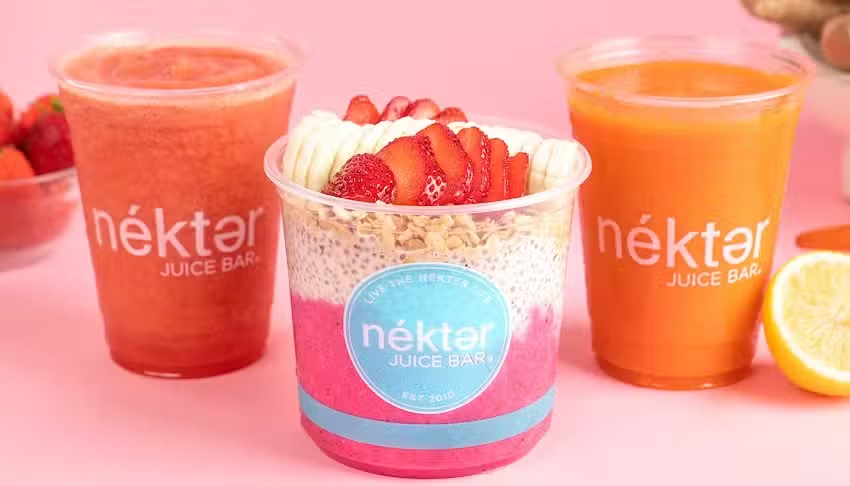
The most consistent and damaging complaints centered on the poor quality of the products themselves. Multiple customers reported receiving items that were fundamentally flawed. One patron described their bowl as being "just liquid," a far cry from the thick, scoopable consistency expected of high-quality acai bowls. Another recounted ordering two smoothies that arrived completely melted, resembling "slop rather then an actual smoothie." These weren't isolated incidents. A third review highlighted smoothies that were so "badly blended" and "chunky" that they were nearly undrinkable. These experiences point to a systemic failure in preparation and quality control within the ghost kitchen environment, failing to deliver even the most basic product correctly.
This issue was compounded by what customers felt were exorbitant prices for substandard products. Orders costing between $17 and $40 left patrons feeling cheated. One review lamented paying $17 for a chunky smoothie a "toddler could've made," while another called a $24+ order for two melted drinks an "outrageous price." When a premium is charged for healthy smoothies and bowls, the expectation is a premium product. This location consistently failed to meet that expectation, creating a severe mismatch between cost and value.
Operational Shortcomings and Customer Service Issues
Beyond product quality, the operation was plagued by logistical problems. One prospective customer drove 30 minutes in traffic only to find the location unattended during its stated business hours, a frustrating experience that guaranteed they would "never again" return. Delivery orders also suffered, with one taking nearly an hour to arrive, by which time the product was melted and unpalatable. Such operational inconsistencies suggest a lack of dedicated management and staffing, a common risk when a brand's identity is diffused within a larger, host kitchen.
When things went wrong, the customer service response appeared to be just as disappointing. One customer, after spending approximately $40 on a terrible order, was allegedly denied a refund. This refusal to make amends for a demonstrably poor experience added insult to injury and solidified the negative impression. Another key piece of feedback came from this same customer, who was told by customer service that the location was "not an actual Nektar store but a doordash facility where they sell Nektar," confirming the ghost kitchen arrangement and the brand's attempt to distance itself from the location's failures.
The Bigger Picture: A Failed Experiment
This Nekter's story is intertwined with the broader ambitions and subsequent failure of the Kitchen United and Kroger partnership. Announced in 2022, the plan was to open several Mix Food Hall locations in Columbus-area Krogers, offering a variety of restaurant brands under one roof. However, by late 2023, Kitchen United had closed all its in-store Kroger locations, pivoting its business model away from physical kitchens entirely. The permanent closure of this Nekter smoothie shop was not just an isolated failure but part of a larger, unsuccessful corporate venture.
While the vast majority of feedback was negative, it is worth noting a single four-star review that described the location as a "nice smoothie window" while also conceding that it was "a little expensive." This lone positive comment, however, is drowned out by the chorus of dissatisfaction regarding quality, service, and value. For those seeking fresh juice or a reliable juice cleanse program, this location offered none of the consistency or quality assurance expected from an established chain. Ultimately, the Nekter Juice Bar at 3417 N High St serves as a cautionary tale about how a brand's reputation is only as strong as its weakest link, especially when execution is outsourced to a model that, in this case, failed to uphold its most basic promises.